How to build an expedition yacht
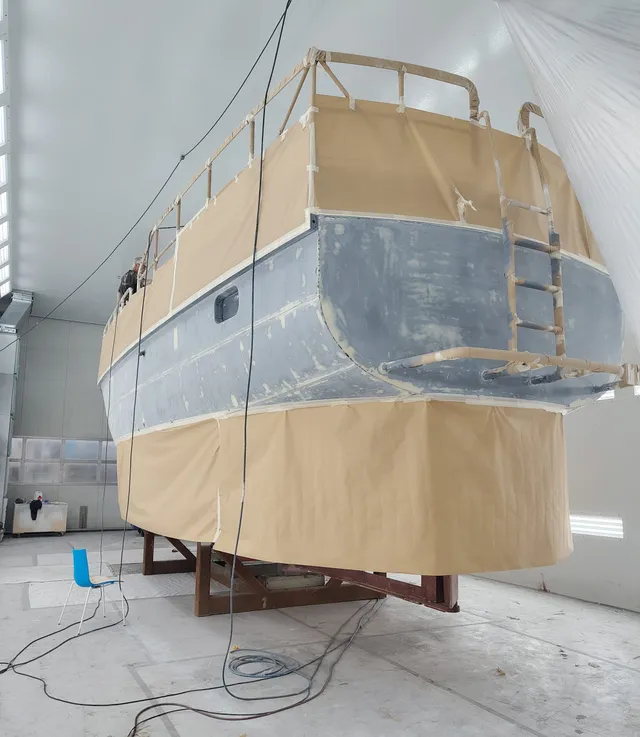
As someone who's job it is to find out where products and materials come from, I was immediately curious where the Amundsen, our "extreme sailing machine" for the journey to Antarctica, was actually made. Turns out, not too far, and not too surprising: in the Netherlands, a country with a century-long shipbuilding tradition, from medieval fishing vessels to the vast merchant (and colonial) fleet during the 16th and 17th century, up to today's high-end specialised maritime engineering.
On a whim, I reached out to KM Yachtbuilders, the shipyard where the Amundsen was designed and constructed in 2024. And to my surprise, they invited me for a personal tour of the yard. So, on a rainy and windy October day, I rented an EV and drove all the way to Makkum, a small Frisian village nestled just behind the Afsluitdijk on the IJsselmeer. A perfect place to take shiny new yachts for a first sea trial once they leave the big warehouses of Makkum's shipbuilding industry - an economy that has been built over generations of maritime metalworkers, woodworkers and riggers.
Aluminium skeletons
This is also how KMY started in 1998: By taking over the aluminium yard next door, the ship repair and storage business moved into building its own specialised aluminium vessels. Three times lighter than steel, as strong and without the propensity to rust, aluminium alloys are the material of choice for high performance yachts like the Amundsen. Fittingly, the big and noisy metal welding hall is where my tour starts.
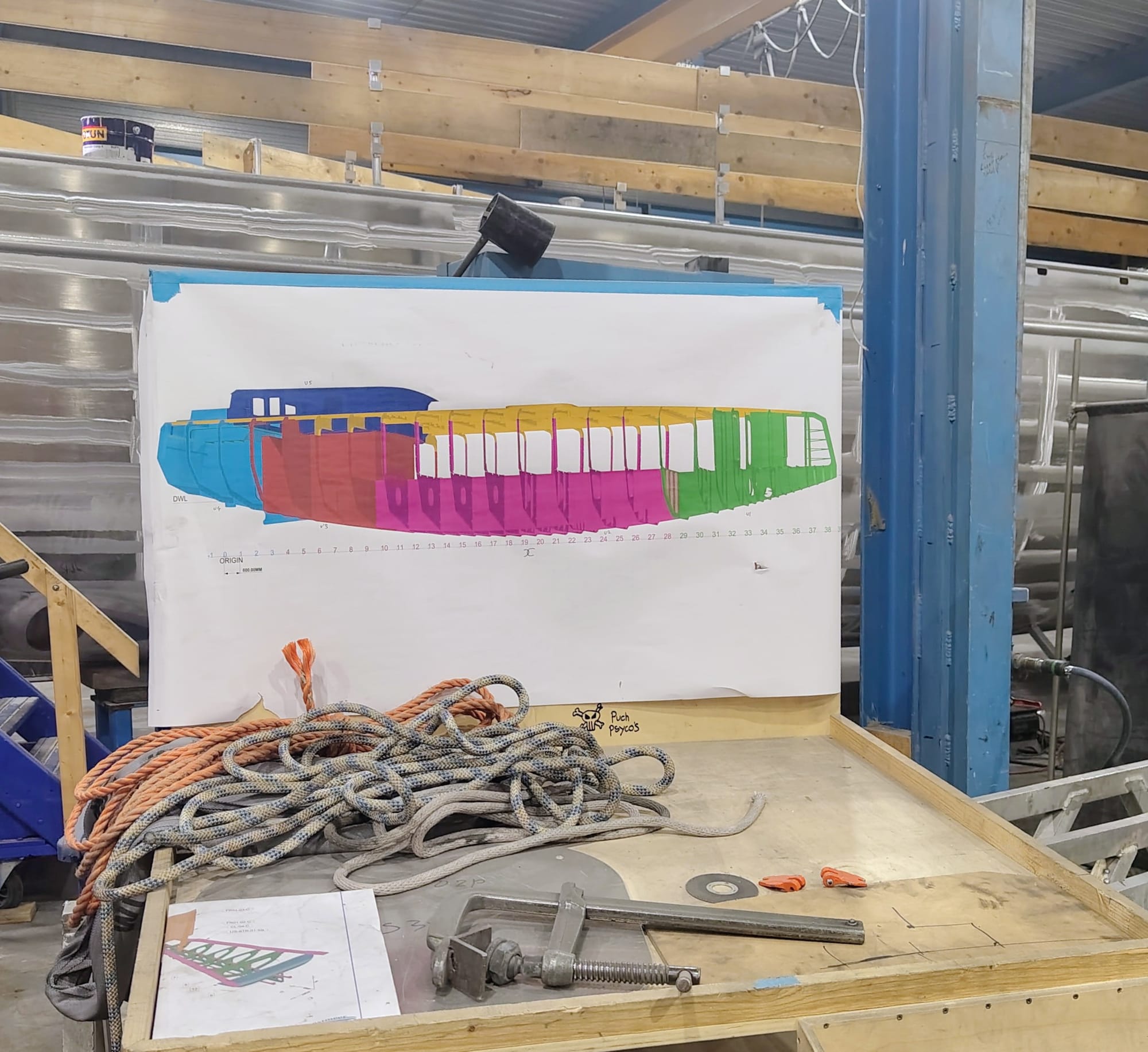
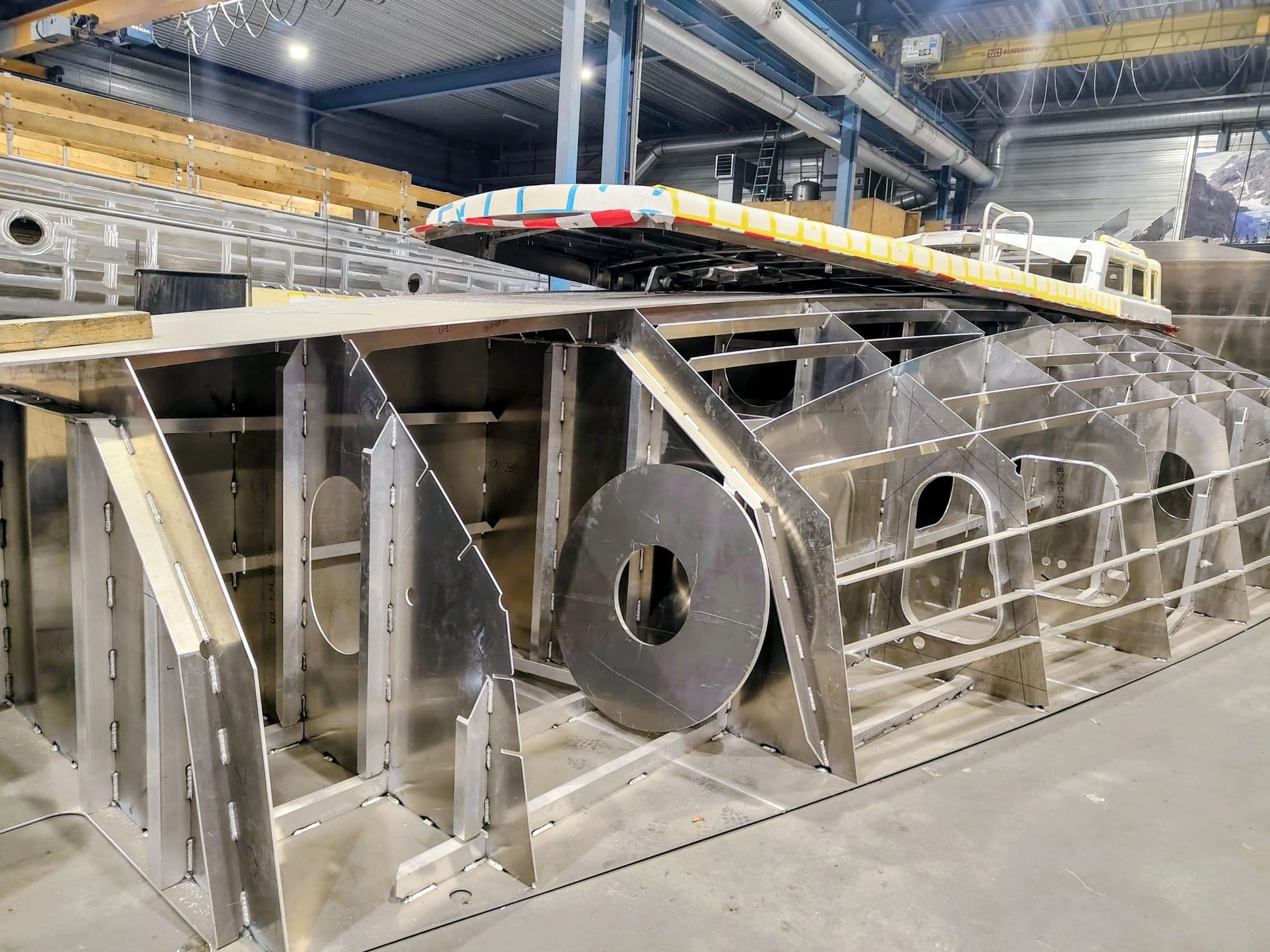
Design of the aluminium hull (left), and the upside-down skeleton (right).
At first, a ship is nothing but thin, flat, square aluminium sheets piled on top of each other - delivered to the yard from several European aluminium suppliers. These are then sawn, bent, and welded into a metal skeleton lying upside down - curiously reminding me of the blue whale skeleton in the Natural History Museum in London. About 70-80% of the aluminium is already from recycled sources, though reaching maritime-grade specifications of durability and strength makes it difficult to go beyond that at present.
Once the hull is turned and the boathouse welded on top, this halfling of a boat is moved to the next hall. Here, the interior is fitted with piping and plumbing, the engine control room, electronics for navigation, and of course also the cabins, kitchen and living area. A whole floor of the hall is reserved for carpentry and woodworking. Though it's relatively quiet when I visit, dozens of machines and shelves full of bolts, nuts, pipes and cables hint at what it means to build the interior life support system of a ship. Here, wood and bamboo are cut, sanded down, fitted and screwed together - first in a walkable 3D model, and later on the ship itself.
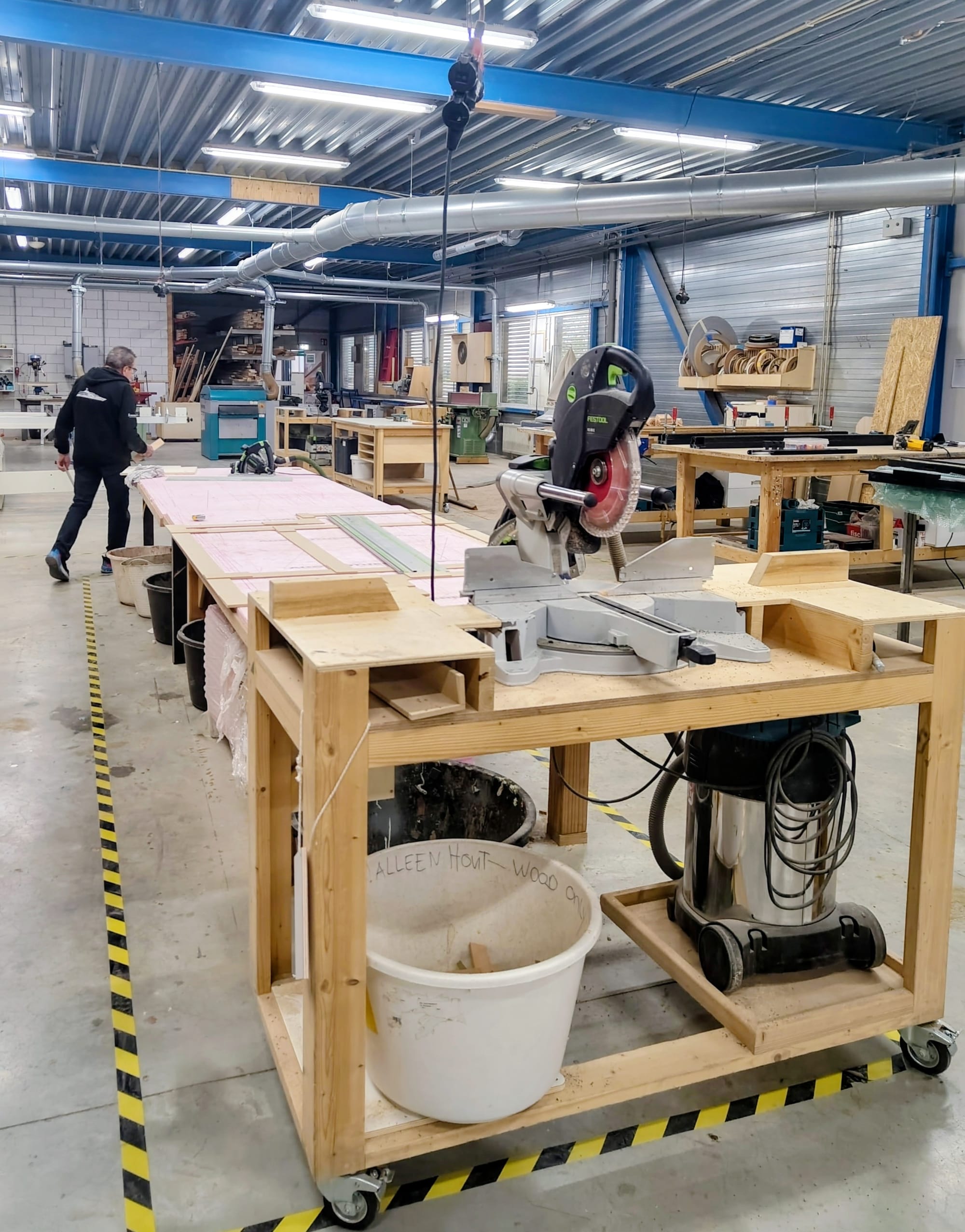
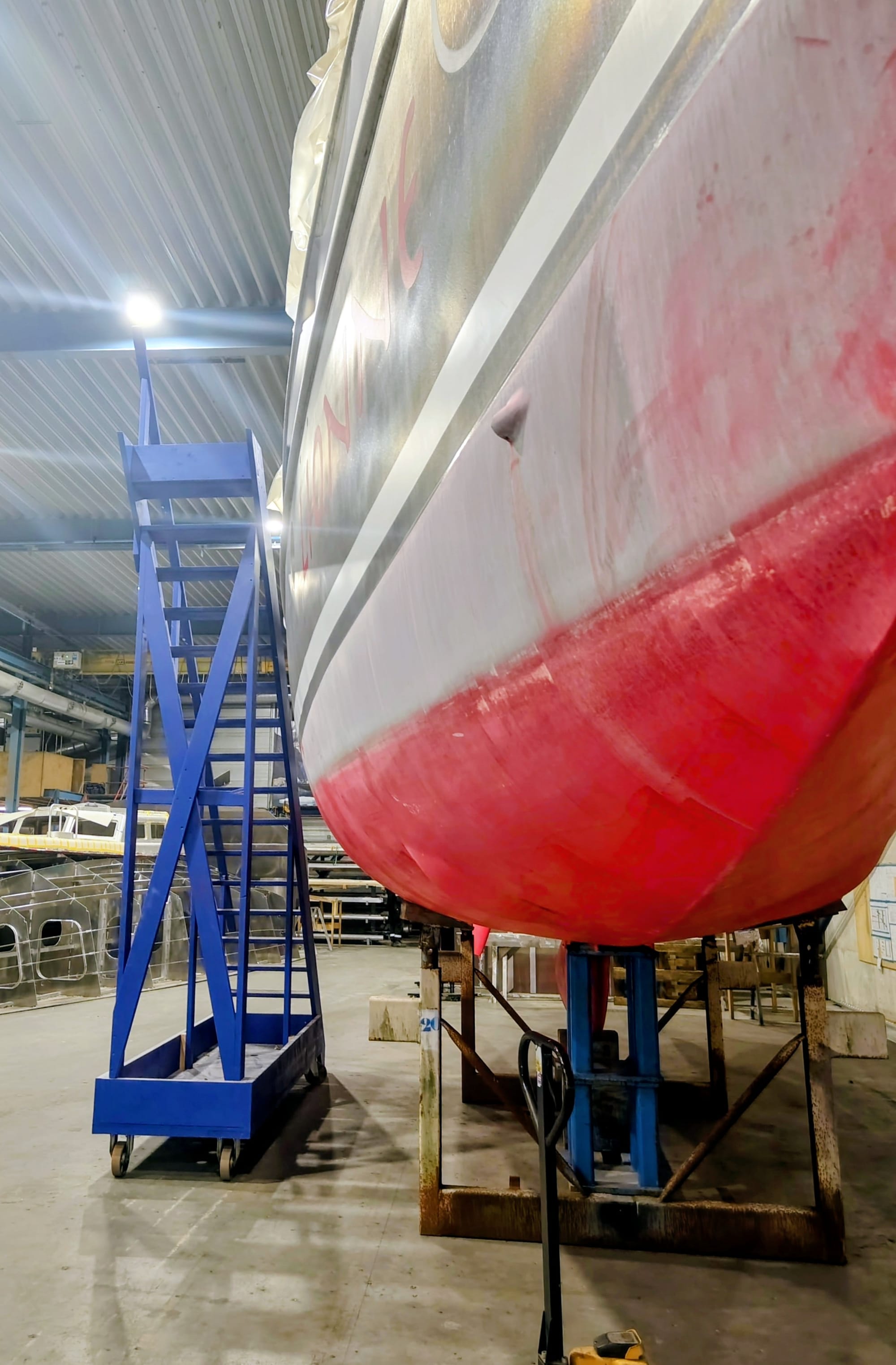
Carpentry floor (left) and a boat being refitted (right)
The inevitable plastics
I am of course also curious about plastics, given the purpose of the Antarctic mission I am joining. It's not currently possible to create a ship like the Amundsen entirely plastics free. Sails and ropes are typically made of polyesters and nylon or other synthetic fibers; the electronics, wiring, and sealing contain plastics, the windows are acrylic and polycarbonate, and the insulation is made of polymer foams. But KMY has been experimenting with more sustainable alternatives, for example using recycled PET for sails and rigging, and mineral wool or cork for insulation. For one of their yachts, the award-winning Bestevaer 36 S/Y, they also conducted a full Lifecycle Analysis (LCA) to better understand where material choices and production methods could be improved for the environment.
Going fully electric
This is not common practice in yacht building yet, though it seems that demand for environmentally conscious and sustainable design and construction is on the rise. In fact, I am allowed to see what KMY calls their most exciting project currently: A large hull, already brightly blue painted, and with the interior being outfitted with wood works. Besides the unusual square windows in the hull, I could not have guessed its exceptionalism: This is the first fully electric yacht being built at KMY. (I am unfortunately not allowed to take pictures of it, as the owner would like to keep it private).
Going fully electric is of course much harder to do for ships like the Amundsen, who have to operate autonomously in the remotest places and the roughest weather for a long time. But even this is slowly changing - Arctic captain Sophie Galvagnon, CEO of Selar Expeditions, has just launched Captain Arctic, a fully solar and wind powered Arctic explorer yacht using wood pellets for heating, earlier in 2026.
Craftwork under one roof
Past the (re-)fitting and wood workshops, I am led to the painting hall, the last step inside the warehouse, before a ship is exposed to the elements for masting and rigging. In what looks like giant, neon-illuminated fridges, the ships' hulls and other parts like the rudders, are spray painted and treated with antifouling solutions. The temperature inside these halls is kept stable, and huge air filters constantly remove all particles and dust. It feels like the most comfortable working space in the entire shipyard, apart of course from the cozy offices.
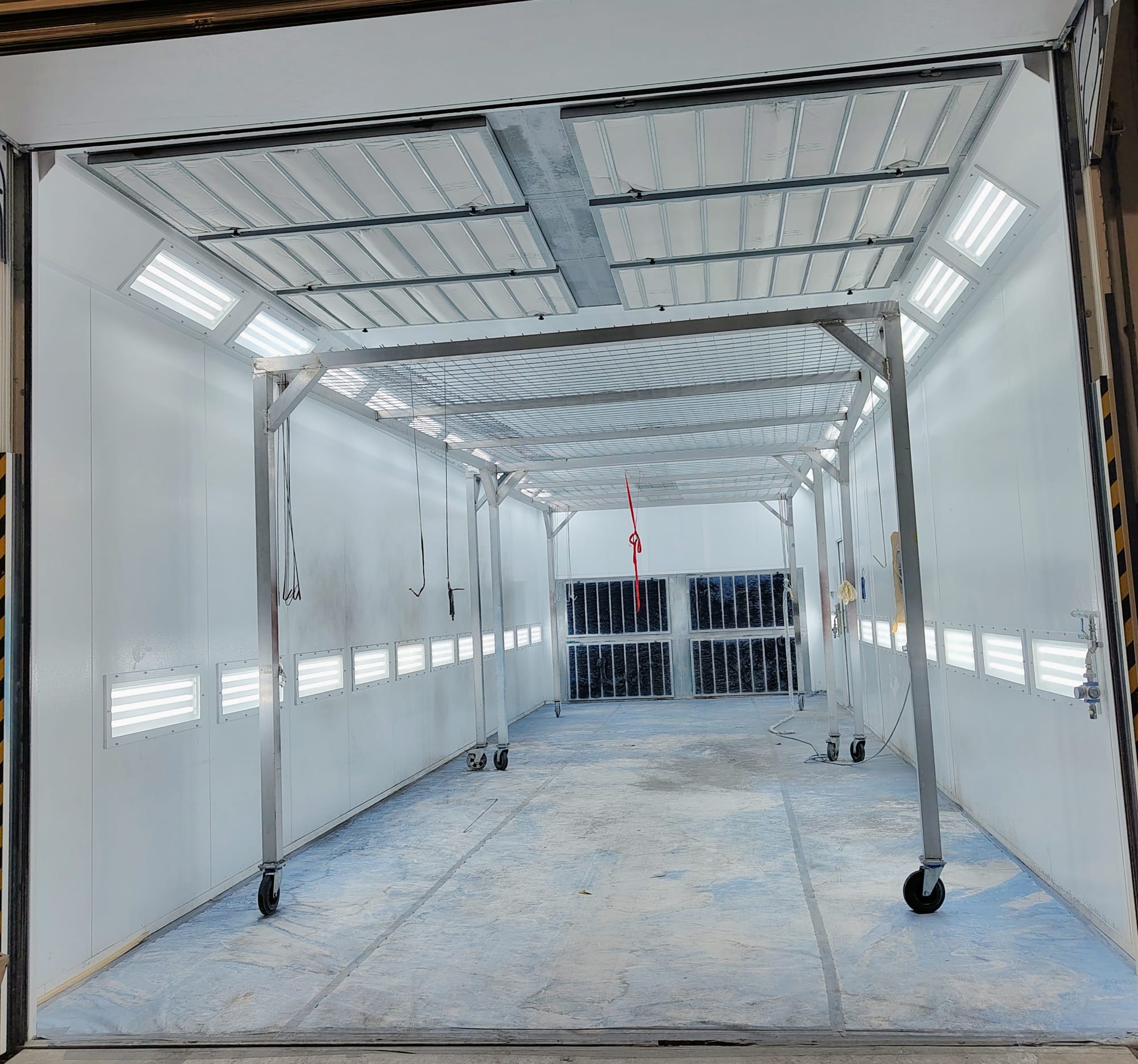
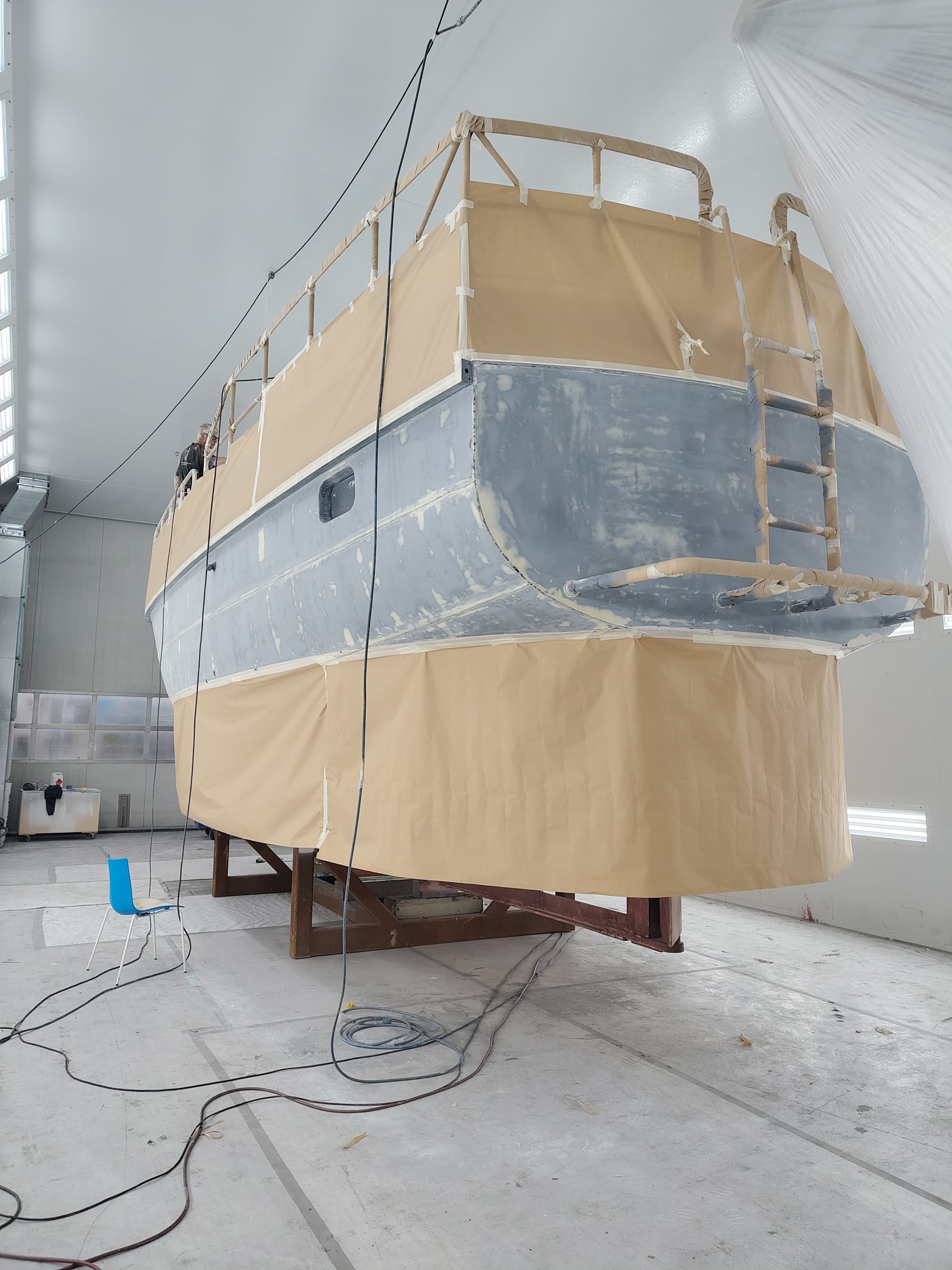
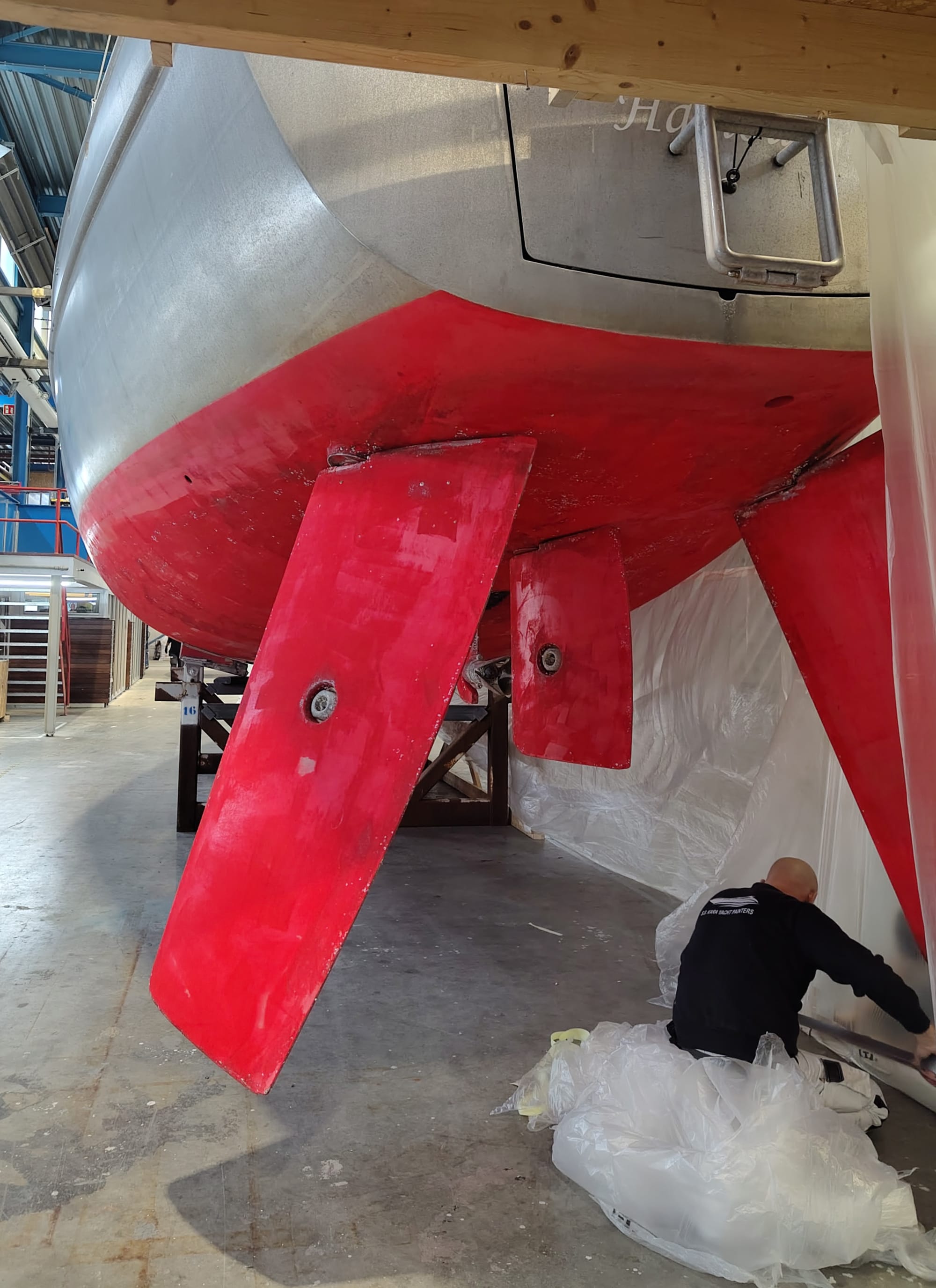
The painting "fridge" (left), and hulls being painted (middle and right)
It is a speciality of KM Yachtbuilders to offer every design and construction step under one roof. This allows for accurate planning and efficient working - and it also means that KMY employs a wide range of specialised professions and craftspeople in house. The team consists of around 70 people, each of them involved at one step or another in the building of a ship: welding, carpentry, mechanical and electrical engineering, electronics and navigation experts, interior systems installators, rigging, painting, as well as technical design and project management. Some of them have worked at the yard for more than 20 years already, now passing on their skill and knowledge to the next generation.
The customers? "Men"
I ask whether KMY still finds youth who want to learn vocational professions - but that unfortunately seems as difficult as in other sectors. Even though at the yard, no day is the same, and it certainly does not get boring. Each boat is unique and completely customised. For a yacht like the Amundsen, it usually takes more than a year from the first design drawings to the installing of the masts, rigging and sails, and the water launch. The price point? 4 - 4.5 million Euros. When I ask who KMY's main customers are, the answer comes quick: "Men". Usually older, and mostly European. I guess sailing historically has been - and still remains - largely male-dominated.
Commissioning a ship like the Amundsen needs a deep pocket - or a solid business plan to rent it to scientific missions or high latitude sailing expeditions over many years. But these ships are also built to last. Their life can last 50 years or more with the appropriate maintenance and repair. Refitting and refurbishing is also common, and some parts like the sails can be re-manufactured into other products once they need to be replaced.
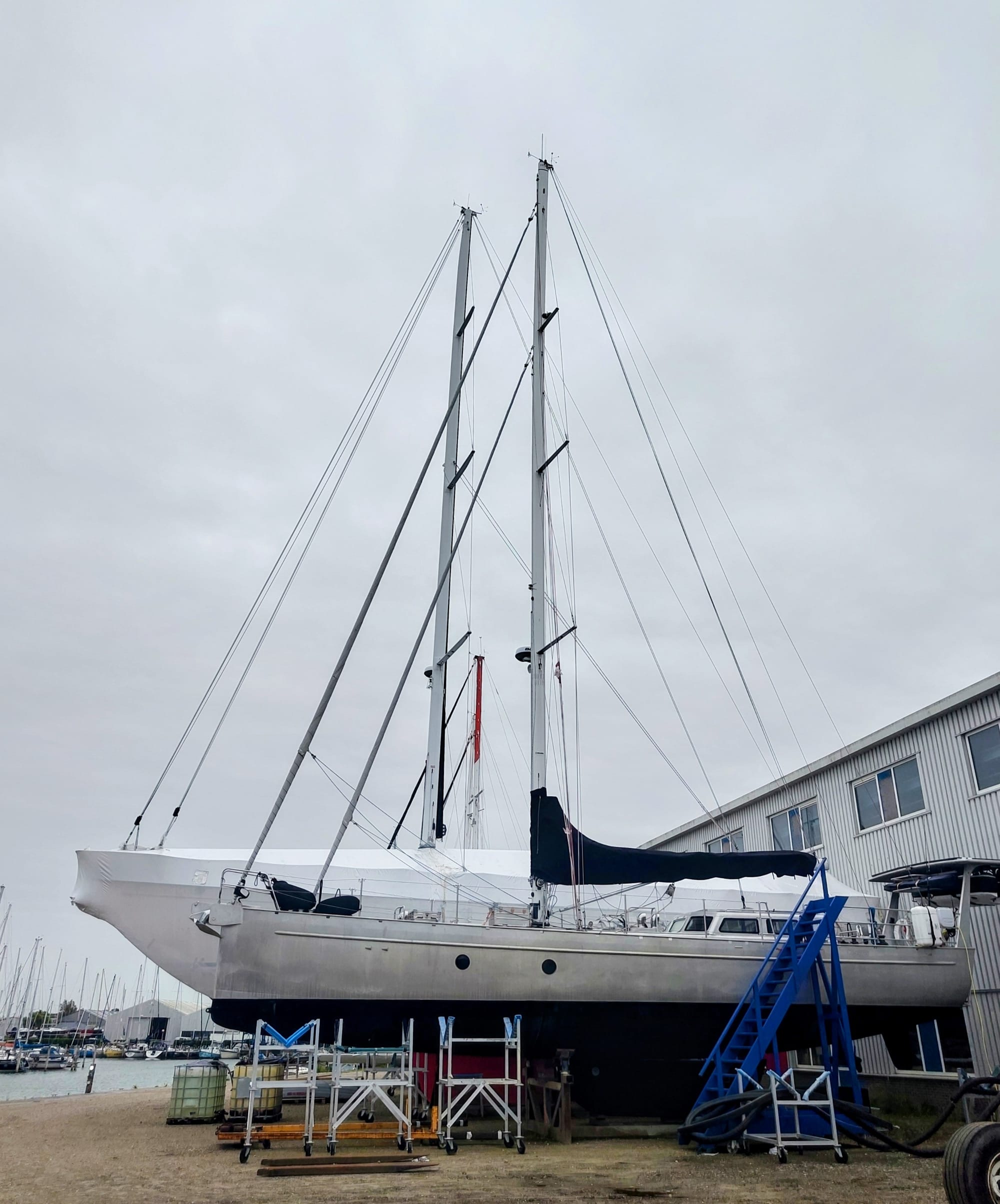
Rigged, masted - and almost ready for the seas.
One for the family album
At KM Yachtbuilders, they continue to follow each ship they built, long after it leaves the yard. At the end of the tour, I get served a tea, and a pile of books of every ship constructed. Like family photo albums, they show the yachts growing up and leaving the house: From the first sea trial on the IJsselmeer and the North Sea to the Seven Seas. Before I leave, I promise the team to send some more pictures of the Amundsen braving the Drake passage and sailing the Antarctic peninsula, all grown up and exploring the world.
You can learn more about KM Yachtbuilders here. A big thank you to Nynke, who gave me a very warm welcome and answered all my many questions during the tour!
Wie man eine Expeditionsjacht baut
Als jemand, deren Aufgabe es ist herauszufinden, woher Produkte und Materialien kommen, war ich sofort neugierig, wo die Amundsen, unsere „extreme Segelmaschine“ für die Reise in die Antarktis, eigentlich gebaut wurde. Wie sich herausstellt, gar nicht so weit weg und wenig überraschend: in den Niederlanden – einem Land mit jahrhundertealter Schiffbautradition, von mittelalterlichen Fischerbooten über die riesige Handels- (und Kolonial-)Flotte des 16. und 17. Jahrhunderts, bis hin zur heutigen hochspezialisierten maritimen Ingenieurskunst.
Spontan nahm ich Kontakt zu KM Yachtbuilders auf, der Werft, auf der die Amundsen 2024 entworfen und gebaut wurde. Zu meiner Überraschung luden sie mich zu einer persönlichen Führung über das Werftgelände ein. An einem regnerischen und windigen Oktobertag mietete ich mir also ein Elektroauto und fuhr bis nach Makkum, einem kleinen friesischen Dorf direkt hinter dem Afsluitdijk am IJsselmeer. Ein perfekter Ort, um nagelneue Jachten einer ersten Probefahrt auf See zu unterziehen, nachdem sie die großen Hallen der Makkumer Schiffbauindustrie verlassen haben – eine Wirtschaft, die über Generationen von maritimen Metallarbeitern, Tischlern und Taklern aufgebaut wurde.
Skelette aus Aluminium
So begann auch KMY im Jahr 1998: Durch die Übernahme des benachbarten Aluminiumbetriebs begann die Schiffsreparatur- und Lagerfirma auch eigene, spezialisierte Aluminiumschiffe zu bauen. Dreimal leichter als Stahl, ebenso stark und ohne die Neigung zu rosten, sind Aluminiumlegierungen das Material der Wahl für Hochleistungsjachten wie die Amundsen. Passenderweise beginnt auch meine Tour in der großen und lärmigen Metallschweißhalle.
Zu Beginn ist ein Schiff nichts weiter als dünne, flache, quadratische Aluminiumbleche, die aufeinandergestapelt sind – geliefert von verschiedenen europäischen Aluminiumlieferanten. Diese werden dann gesägt, gebogen und zu einem auf dem Kopf stehenden Metallskelett verschweißt, das mich merkwürdigerweise an das Blauwalskelett im Natural History Museum in London erinnert. Etwa 70 bis 80 % des Aluminiums stammen bereits aus recycelten Quellen. Mehr sind derzeit noch schwierig, wenn gleichzeitig die maritimen Spezifikationen für Haltbarkeit und Festigkeit erfüllt sein müssen.
Sobald der Rumpf gedreht und das Deckshaus darauf verschweißt ist, wird dieser Bootsrohling in die nächste Halle gebracht. Hier wird der Innenraum mit Rohrleitungen und Sanitäranlagen, dem Maschinenkontrollraum, der Elektronik für die Navigation und natürlich den Kabinen, der Küche und dem Wohnbereich ausgestattet. Eine ganze Etage der Halle ist für die Tischlerei und Holzbearbeitung reserviert. Obwohl es bei meinem Besuch relativ ruhig ist, deuten Dutzende von Maschinen und Regale voller Bolzen, Muttern, Rohre und Kabel darauf hin, was es bedeutet, das innere Lebenserhaltungssystem eines Schiffes zu bauen. Hier werden Holz und Bamboo zugeschnitten, geschliffen, eingepasst und verschraubt – zuerst in einem begehbaren 3D-Modell und später auf dem Schiff selbst.
Das unvermeidliche Plastik
Ganz im Sinne meiner anstehenden Antarktis-Mission bin ich natürlich auch neugierig auf das Thema Plastik. Es ist derzeit nicht möglich, ein Schiff wie die Amundsen komplett plastikfrei zu bauen. Segel und Taue bestehen typischerweise aus Polyester und Nylon oder anderen Synthetikfasern; die Elektronik, Verkabelung und Dichtungen enthalten Kunststoffe, die Fenster bestehen aus Acryl und Polycarbonat und die Isolierung wird aus Polymerschaumstoffen gefertigt. KMY experimentiert jedoch mit nachhaltigeren Alternativen, wie etwa der Verwendung von recyceltem PET für Segel und Takelage sowie Mineralwolle oder Kork zur Isolierung. Für eine ihrer Jachten, die preisgekrönte Bestevaer 36 S/Y, führten sie außerdem eine vollständige Ökobilanz (Life Cycle Assessment) durch, um besser zu verstehen, wo Materialauswahl und Produktionsmethoden zugunsten der Umwelt verbessert werden können.
Der Weg zum reinen Elektroantrieb
Im Jachtbau ist das noch keine gängige Praxis, obwohl die Nachfrage nach umweltbewusstem und nachhaltigem Design und Bau zu steigen scheint. Tatsächlich darf ich mir das derzeit spannendste Projekt von KMY ansehen: Ein großer, bereits leuchtend blau lackierter Rumpf, dessen Innenraum gerade mit Holzarbeiten ausgestattet wird. Abgesehen von den ungewöhnlichen quadratischen Fenstern hätte ich seine Besonderheit nicht erraten können: Es handelt sich um die erste vollelektrische Jacht, die bei KMY gebaut wird. (Leider durfte ich keine Fotos davon machen, da der Eigentümer sie privat halten möchte).
Ein volles Umsteigen auf Elektroantrieb ist bei Schiffen wie der Amundsen, die über lange Zeiträume autonom in den entlegensten Gebieten und bei rauestem Wetter operieren müssen, natürlich deutlich schwieriger. Aber auch das ändert sich langsam – die arktische Kapitänin Sophie Galvagnon, CEO von Selar Expeditions, hat Anfang 2026 mit der Captain Arctic eine rein solar- und windbetriebene Arktis-Expeditionsjacht vom Stapel gelassen, die Holzpellets zum Heizen nutzt.
Handwerk unter einem Dach
Vorbei an den Refit- und Holzwerkstätten werde ich in die Lackierhalle geführt – der letzte Schritt der Bauphase in den Hallen, bevor ein Schiff zum Masten setzen und Takeln den Elementen ausgesetzt wird. In riesigen, neonbeleuchteten Hallen, die aussehen wie resige Kühlschränke, werden die Schiffsrümpfe und andere Teile wie die Ruder gespritzt und mit Antifouling-Anstrichen behandelt. Die Temperatur in diesen Hallen wird stabil gehalten, und riesige Luftfilter entfernen konstant alle Partikel und Staub. Es fühlt sich an wie der komfortabelste Arbeitsplatz auf der gesamten Werft – abgesehen von den gemütlichen Büros natürlich.
Es ist eine Spezialität von KM Yachtbuilders, jeden Design- und Bauschritt unter einem Dach anzubieten. Dies ermöglicht eine präzise Planung und effizientes Arbeiten – und bedeutet auch, dass KMY eine breite Palette spezialisierter Berufe und Handwerker:innen im eigenen Haus beschäftigt. Das Team besteht aus rund 70 Personen, von denen jede in irgendeiner Phase des Schiffbaus eingebunden ist: Schweißen, Tischlerei, Maschinenbau, Elektrotechnik, Elektronik- und Navigationsexperten, Installateure für Innensysteme, Takelage, Lackierung sowie technisches Design und Projektmanagement. Einige von ihnen arbeiten bereits seit mehr als 20 Jahren auf der Werft und geben ihr Wissen und ihr Können nun an die nächste Generation weiter.
Die Kundschaft? „Männer“
Ich frage, ob KMY noch Jugendliche findet, die ein Handwerk erlernen wollen – aber das scheint leider genauso schwierig zu sein wie in anderen Branchen. Dabei gleicht auf der Werft kein Tag dem anderen, und langweilig wird es mit Sicherheit nicht. Jedes Boot ist ein Unikat und wird komplett nach Kundenwunsch gefertigt. Bei einer Jacht wie der Amundsen dauert es von den ersten Entwurfszeichnungen bis zum Setzen der Maste, der Takelage, den Segeln und dem Stapellauf in der Regel mehr als ein Jahr. Der Preis? 4 bis 4,5 Millionen Euro. Auf meine Frage, wer die Hauptkunden von KMY sind, kommt die Antwort prompt: „Männer“. Meist älter und größtenteils Europäer. Nunja, die Seefahrt war historisch gesehen – und scheint es bis heute – weitgehend männerdominiert.
Die Inauftraggabe eines Schiffes wie der Amundsen erfordert tiefe Taschen – oder einen soliden Businessplan, um es über viele Jahre hinweg für wissenschaftliche Missionen oder Segel-Expeditionen in hohen Breitengraden zu vermieten. Aber diese Schiffe sind auch für Langlebigkeit gebaut. Ihre Lebensdauer kann bei entsprechender Wartung und Reparatur 50 Jahre oder mehr betragen. Auch Refittings und Modernisierungen sind an der Tagesordnung, und einige Teile wie die Segel können nach ihrem Austausch zu anderen Produkten weiterverarbeitet werden.
Etwas fürs Familienalbum
Bei KM Yachtbuilders verfolgen sie den Weg jedes gebauten Schiffes noch lange nach dem Verlassen der Werft. Am Ende der Tour bekomme ich einen Tee serviert und einen Stapel Fotobücher über jedes bisher gebaute Schiff. Wie Familienfotoalben zeigen sie, wie die Jachten aufwachsen und das Haus verlassen: Von der ersten Probefahrt auf dem IJsselmeer und der Nordsee bis zu den sieben Weltmeeren. Bevor ich gehe, verspreche ich dem Team, weitere Bilder von der Amundsen zu schicken, wie sie die Drake-Passage meistert und an der Antarktischen Halbinsel entlangsegelt – erwachsen geworden und beim Erkunden der Welt.
Weitere Informationen über KM Yachtbuilders findest Du hier. Ein großes Dankeschön an Nynke, die mich sehr herzlich empfangen und mir während der Führung all meine vielen Fragen beantwortet hat!